Materials science × machine learning

Lane Enrique
Schultz.

Connecting structure, models,
and materials discovery.

I develop machine learning and multiscale simulation workflows to understand materials—and make better decisions about which ones to explore next.

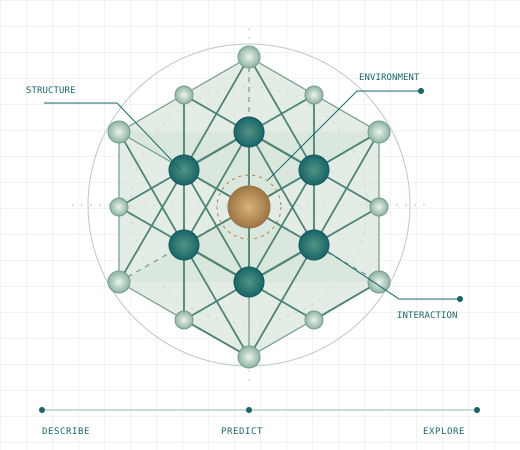
Structure → model → discovery
Conceptual illustration of connected atomic environments, a predictive model, and a materials screening path.
From atomic environments to materials decisions.
Currently

Postdoctoral Appointee / Sandia National Laboratories

Based in

Albuquerque, New Mexico

01 / Research

Materials questions.
Computational answers.

My work connects learning algorithms with physical models, from molecular separations and battery electrolytes to the growth of thin films.

Molecular separations

Learning which frameworks to explore next.

Metal–organic frameworks offer a vast space of porous materials. I combine graph neural networks, uncertainty estimates, and multi-objective Bayesian optimization to screen for favorable separation performance.

Graph neural networks · Bayesian optimization

Published · 2026Paper details
Solid-state batteries

Finding useful tradeoffs in electrolyte microstructures.

A candidate pool of 174,758 LLZO–polymer microstructures provides a testing ground for surrogate-guided screening. The work connects transport and mechanical tradeoffs with interpretable microstructural features.

Multi-objective optimization · Microstructure

In preparation · 2026Manuscript details
Thin-film modeling

Bringing atomic detail into sputtering predictions.

Surface binding energies vary with chemistry and structure. I investigate how atomistically resolved distributions in Mo–S systems propagate through sputtering and deposition models, with experimental sputter yields as a benchmark.

Atomistic simulation · Multiscale modeling

Under review · 2026Manuscript details

Research foundations

Knowing when to trust a prediction.

My doctoral research developed applicability-domain methods for materials machine learning and high-throughput atomistic workflows for metallic glass forming ability. These questions—what a model knows, and what a simulation reveals—continue to guide my work.

Atomistic graph of a metal organic framework, with different atomic species represented by colored spheres.
Structure-informed materials modeling.

02 / Selected publications

Ideas, in print.

All publications & manuscripts
  1. 2026

    Graph neural network-based multi-objective Bayesian optimization for enhanced screening of metal–organic frameworks with optimal separation performance

    Lane E. Schultz, Nickolas Gantzler, N. Scott Bobbitt, Dorina F. Sava Gallis, and Rémi Dingreville.

    Journal of Materials Chemistry A

    Graph neural networks and multi-objective Bayesian optimization for screening metal–organic frameworks with favorable separation performance.

  2. 2025

    A general approach for determining applicability domain of machine learning models

    Lane E. Schultz, Yiqi Wang, Ryan Jacobs, and Dane Morgan.

    npj Computational Materials

    A kernel-density-estimation approach to understanding where a machine learning model's predictions and uncertainty estimates are reliable.

  3. 2025

    Machine learning metallic glass critical cooling rates through elemental and molecular simulation based featurization

    Lane E. Schultz, Benjamin Afflerbach, Paul M. Voyles, and Dane Morgan.

    Journal of Materiomics

    Connecting elemental descriptors and molecular-simulation features to the prediction of metallic glass critical cooling rates.

Explore the complete record, including preprints and ongoing work, on the publications page or Google Scholar.

03 / Background

A computational perspective.
An engineering foundation.

Lane Schultz at graduation, wearing academic regalia.

I’m a materials scientist and engineer at the Center for Integrated Nanotechnologies at Sandia National Laboratories. My work brings together materials physics, scientific computing, and machine learning.

I earned my Ph.D. at the University of Wisconsin–Madison and my engineering degree at Fort Lewis College. Alongside research, I’ve helped build and administer scientific computing clusters and supported students and colleagues in using research software.

Full experience & credentials

Research appointments

  1. Dec 2024 — present

    Postdoctoral Appointee

    Center for Integrated Nanotechnologies
    Sandia National Laboratories

  2. Jun 2018 — Aug 2024

    Research Assistant

    Computational Materials Group
    University of Wisconsin–Madison

Education

  1. 2024

    Ph.D., Materials Science and Engineering

    University of Wisconsin–Madison

    Distributed minor in Machine Learning

  2. 2020

    M.S., Materials Science and Engineering

    University of Wisconsin–Madison

  3. 2017

    B.S., Engineering

    Fort Lewis College

    Electro/Mechanical Engineering concentration · Mathematics minor

Service & community

Contributing beyond the research.

  • Committee member

    Computational Materials Science and Engineering Committee, The Minerals, Metals & Materials Society (TMS).

  • Workshop volunteer / March 15, 2026

    Assisted participants in the in-person Software Development in Materials Science and Engineering workshop at TMS 2026.

Professional development

Continuing to learn.

  • Artificial Intelligence in Materials Science and Engineering

    TMS · Online course
    –

  • Building AI Agents with Multimodal Models

    NVIDIA · Workshop

04 / Contact

Let’s talk materials.

For research collaborations and professional inquiries,
get in touch by email.

laneenriqueschultz@gmail.com

At Sandia: leschul@sandia.gov
Albuquerque, New Mexico · +1 (806) 678-6904